Wednesday, 20 December 2023

Muslim Dr. Gerald Dirks - Muslims in American History Before, With and After Christopher Columbus.

 Muslims in American History - A Forgotten Legacy  2006

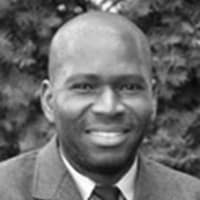
 BY DR. GERALD DIRKS

https://www.youtube.com/watch?v=HCbLcVTex1c&t=11s


BY DR. GERALD DIRKS

 White European US American born Dr. Gerald Dirks puzzled a deluded White RACIST European US American man when he saw Mr. Dirks with a long beard, and his wife wearing an ABAYA, the type made illegal in RACIST ZIONIST CHARLIE-HANUKAH FRANCE that also banned Muslim women decency – the wearing of a head scarf they call a “VEIL”!!!   


Muslims in American History - A Forgotten Legacy  2006

MuslimByChoice

97.8K subscribers 150,819 views 29 May 2009

What do you know about Muslim immigration to America?

When did the earliest Muslims arrive?

When did members of this community first arrive in America?

Dr Jerald Dirk received his Bachelor of Arts (philosophy) from Harvard College in 1971, his Master of Divinity from Harvard Divinity School in 1974, his Master of Arts (clinical child psychology) from the University of Denver in 1976, his Doctor of Psychology (Psy.D.) degree in clinical psychology from the University of Denver in 1978, and his sessions program certificate in Islamic studies from Imam Muhammad ibn Saud Islamic University in 1998.

In 1969, he obtained his License to Preach from the United Methodist Church and was ordained into the Christian ministry (deaconate) by the United Methodist Church in 1972.

 He embraced Islam in 1993 and completed the 'Umrah and Hajj in 1999.

 His vocational history includes over five years teaching in American colleges and universities and over 20 years spent in the private practice of psychotherapy. In addition, he has taught at the middle school level at two different private Islamic schools and has served as the psychoeducational consultant at one private Islamic school.

 Dr. Dirks is the author or co-author of over 60 published articles in the behavioral sciences (primarily in psychosomatic medicine), over 140 published articles on the Arabian horse and its history, and over 220 published articles or formal presentations on Islam, comparative religion, and private Islamic education in America.

 He has lectured widely on Islam at American universities (Tabor College, University of Kansas, University of Denver, Oklahoma State University, Missouri State University, Wayne State University, University of Michigan, University of Pittsburgh, University of Alabama at Birmingham, and Georgetown University), in American mosques (in Arizona, California, Colorado, Georgia, Illinois, Kansas, Michigan, New York, Oklahoma, Pennsylvania, Tennessee, Texas, Utah, and Virginia), and at regional and national conventions of the major Islamic organizations (ISNA, ICNA, and MAS).

 In addition, he has been interviewed about Islam by newspapers in California, Colorado, Missouri, and Occupied Saudi Arabia and by television stations in Kansas, New York, Texas, Utah, Canada, and the United Arab Emirates.

 He is the author of four books that explore the commonalities and differences among the three Abrahamic religions (Islam, Christianity, and Judaism): The Cross and the Crescent, now in its second printing; Abraham, The Friend of God; Understanding Islam--A Guide for the Judaeo-Christian Reader; and The Abrahamic Faiths--Judaism, Christianity, and Islam.

 His fifth book, Muslims in American History--A Forgotten Legacy was published in 2006 and celebrates the centuries-old history of Muslims in America.

 His sixth book, Letters to My Elders in Islam, was published in 2008. Dr. Dirks has also proofread and/or edited several books for other authors.

 The Topic: Muslims in American History: A Forgotten Legacy A talk by Dr Jerald Dirks http://www.dirksonlinebooks.com/

 A forgotten history

For more than 300 years, Muslims have influenced the story of the US – from the ‘founding fathers’ to blues music today.
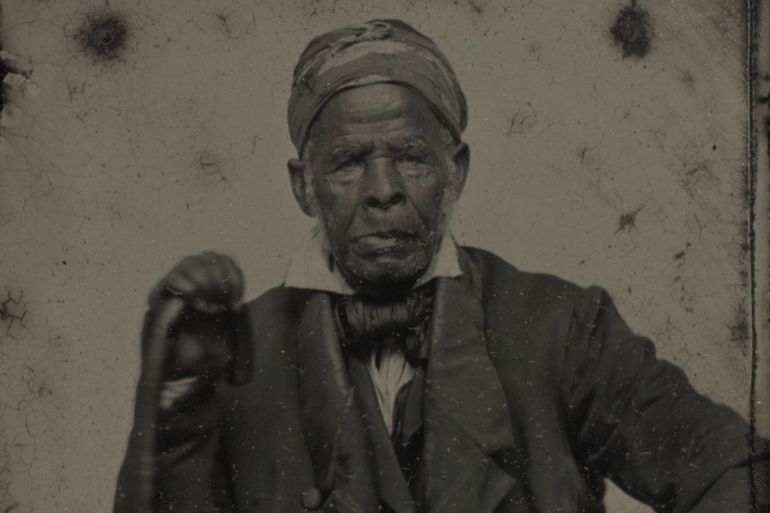
Omar ibn Said, born in Senegal in 1770, held onto Islamic practices while enslaved for decades in the US [Beinecke Rare Book and Manuscript Library, Yale University]

Omar ibn Said, a Muslim, was born in 1770 in Senegal and by the time of his death, he had been enslaved for 56 years. In 2021, Omar, an opera about his life, will premiere at the Spoleto Festival in Charleston, South Carolina.

Muslims are usually thought of as 20th-century immigrants to the US, yet for well over three centuries, African Muslims like Omar were a familiar presence. They had grown up in Senegal, Mali, Guinea, Sierra Leone, Ghana, Benin and Nigeria where Islam was known since the 8th century and spread in the early 1000s.

Estimates vary, but they were at least 900,000 out of the 12.5 million Africans taken to the Americas. Among the 400,000 Africans who spent their lives enslaved in the United States, tens of thousands were Muslims.

Though they were a minority among the enslaved population, Muslims were acknowledged like no other community. Slaveholders, travellers, journalists, scholars, diplomats, writers, priests and missionaries wrote about them. Founder of Georgia James Oglethorpe, Presidents Thomas Jefferson and John Quincy Adams, Secretary of State Henry Clay, author of the US national anthem Francis Scott Key, and portraitist of the Founding Fathers Charles W Peale were acquainted with some of them.

Visible manifestations of faith

Part of the Muslims’ conspicuousness was due to their continued observance, whenever possible, of the most noticeable tenets of their religion. Prayer, the second pillar of Islam, was one of these visible manifestations of faith noted by enslaved and enslavers alike.

In his 1837 autobiography, Charles Ball, who escaped slavery, related in great detail the story of a man who prayed aloud five times a day in a language others did not understand. He added, “I knew several, who must have been, from what I have since learned, Mohamedans; though at that time, I had never learned of the religion of Mohamed.”

Charles Spalding Willy had this to say about Bilali from Guinea, enslaved by his grandfather on Sapelo Island, Georgia: “Three times each day he faced the East and called upon Allah.” He witnessed other “devout Mussulmans, who prayed to Allah morning, noon and evening.”

Yarrow Mamout, another highly visible Muslim, was taken from Guinea in 1752 when he was about 16. After 44 years of slavery, he was freed and bought a house in Washington, DC. Mamout was a kind of celebrity who was “often seen and heard in the streets singing Praises to God – and conversing with him,” stated noted artist Charles Willson Peale.
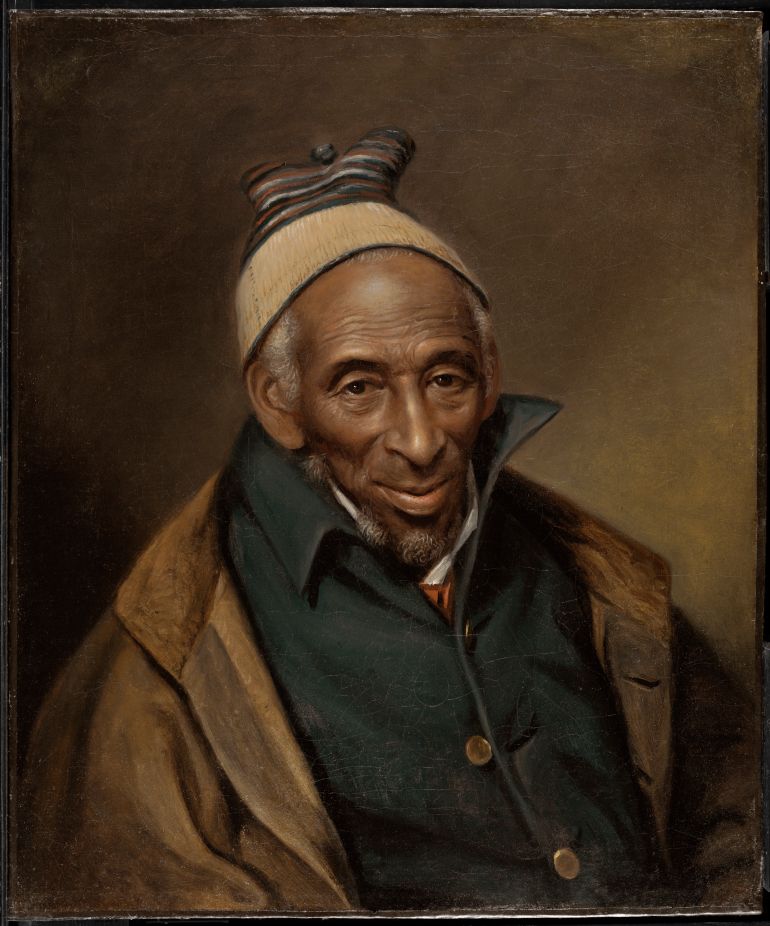
A portrait of Yarrow Mamout by artist Charles Willson Peale, made in Georgetown, Washington, DC in 1819 [Philadelphia Museum of Art]

In the 1930s, men and women formerly enslaved in Georgia described how their relatives and others prayed several times a day: they knelt on mats, bowed, said strange words, and had “strings of beads” or misbahs. As Bilali pulled the beads, one descendant recalled, he said “Belambi, Hakabara, Mahamadu.”

Privacy Policy

It is hard to imagine how people in dismal poverty could give alms, the third pillar of Islam, but still, charity proved to be the most widespread and resilient of all the Muslims’ religious practices.

In the Sea Islands, the women left their mark on this tradition. In the 1930s, their descendants recalled with fondness the rice cakes their mothers gave to children. There was a word for it: Saraka, followed after the sharing by “Ameen, Ameen, Ameen.”

Rice cakes are the charity still offered by West African Muslim women on Fridays. The cake is not called saraka, but the act of giving is a sadaqa, a freewill offering, and that word is uttered as the women give it.

Reflecting the Muslims’ influence, non-Muslims all over the Caribbean to this day offer saraka, unaware of its Islamic origin.

Fasting and dietary requirements

There is no doubt that Islam’s fourth pillar, fasting, was exceedingly hard for people underfed and overworked. Nevertheless, Bilali and his large family used to fast during Ramadan. And so did his friend Salih Bilali. Abducted in Mali when he was about 14, 60 years later he was still “a strict Mahometan; [he] abstains from spirituous liquors, and keeps the various fasts, particularly that of the Rhamadan” wrote his “owner”, James Hamilton Couper.

Omar ibn Said was said to have fasted too. Others whose lives were not recorded may have used the same subterfuge as Muhammad Kaba in Jamaica: Whenever he had to fast, he pretended to be sick.

Several testimonies mention Islam’s dietary restrictions. Throughout his long life, Yarrow Mamout told people, “it is no good to eat Hog [and] drink whiskey is very bad.”

In Mississippi, the son of a prince acknowledged the difficulty of adhering to these rules since slaveholders provided the food. He said “in terms of bitter regret, that his situation as a slave in America, prevents him from obeying the dictates of his religion. He is under the necessity of eating pork but denies ever tasting any kind of spirits.”

In South Carolina, a man only known as Nero was more fortunate, he drew his ration in beef instead. By fasting and refusing certain food Muslims were not only remaining faithful to their religion, they were also asserting a degree of control over their lives.

Distinguished by their dress

In addition to respecting the tenets of Islam, Muslims distinguished themselves, when possible, by the way they dressed. In Georgia, some women wore veils while men sported Turkish fez or white turbans.

An 1859 article described how, each morning, Omar ibn Said nailed the end of a long strip of white cotton to a tree and, holding the other end, wrapped it around his head, fashioning a turban. Daguerreotypes show him with printed fabric around his head or a wool hat. In his portrait, painted in 1819 by Charles W Peale, Mamout wore the same kind of hat as Omar’s.

In 1733, the Senegalese Ayuba Suleyman Diallo insisted on being immortalised in his “country dress” with a white turban and a robe. Likewise, some Muslims in Trinidad, Brazil, and Cuba were described as wearing “flowing robes”, skullcaps and wide pants.

By short-circuiting the coarse, demeaning slave clothes, the Muslims who could do so were reclaiming a bit of ownership of their own bodies, while stating their fidelity to their religion.

A portrait of Ayuba Suleiman Diallo by English artist William Hoare, circa 1733 [Jamestown-Yorktown Foundation collection, on display at the American Revolution Museum at Yorktown]

Curiosity and literacy

Besides being visible, Muslims generated much curiosity because of their literacy, an Islamic requirement because believers need to read the Quran.

This literacy was acquired in schools and, for the most educated, in local or foreign institutions of higher learning. This particularity set them apart from the non-Muslim Africans as well as many illiterate Americans, enslaved and free.

A slaveholder looking for a 30-year-old recent arrival listed only one characteristic in an 1805 runaway notice: he was a man “of grave countenance who writes the Arabic language”.

Two years later, Ira P Nash, a physician and land surveyor, brought to Thomas Jefferson’s attention – in three letters and one meeting – the tribulations of two Muslims. Captured in Kentucky, they escaped to Tennessee where they were jailed and escaped twice more. He gave Jefferson two pages they had written in Arabic. They included the last surah (chapter) of the Quran, al-Nas, Humanity, which speaks of refuge with Allah and evil, a perfect analogy to their situation.

Looking for a translation Jefferson sent the papers to scholar and abolitionist Robert Patterson. He thought the writings were about the men’s “history, as stated by themselves”.

Presumably, based on what that story would reveal, the president was willing to “procure the release of the men if proper”. However, their trace was lost before he could intervene.

Writing for fellow Muslims

Today, manuscripts, from Brazil and Panama to the Bahamas, Trinidad and Haiti still exist. Written by anonymous Muslims and a few known ones, they cover Quranic chapters, prayers, talismans, invocations, and admonitions for the Muslims to remain faithful to Islam. Several are linked to the 1835 Muslim uprising in Bahia.

In about 1823 Muhammad Kaba Saghanughu, who had been captured in 1777 on his way to Timbuktu and deported to Jamaica, wrote a 50-page document in Arabic. Addressed to the “community of Muslim men and women,” it is an instructional manual on praying, marriage and ablutions, and contains commentaries and references to classic Islamic texts.

In contrast to autobiographies by formerly enslaved people, including Africans such as Olaudah Equiano, the Muslims were writing for their own community, not a Western audience.

In the US, Bilali wrote a 13-page document, part of a work by the 10th-century Tunisian Ibn Abu Zayd al-Qairawani. It was written on paper produced in Italy for the North African market, which raises intriguing questions as to how he acquired it.

Salih Bilali, wrote his owner, “reads Arabic, and has a Koran (which however, I have not seen) in that language, but does not write it.” Similarly, Bilali who “kept all the plantation ‘Acts’ in Arabic … was buried with his Koran and praying sheep skin.”

These casual mentions of Qurans on remote plantations beg the question of where they got them. Perhaps, as other memorisers of the Quran did in the Americas, they wrote them themselves.
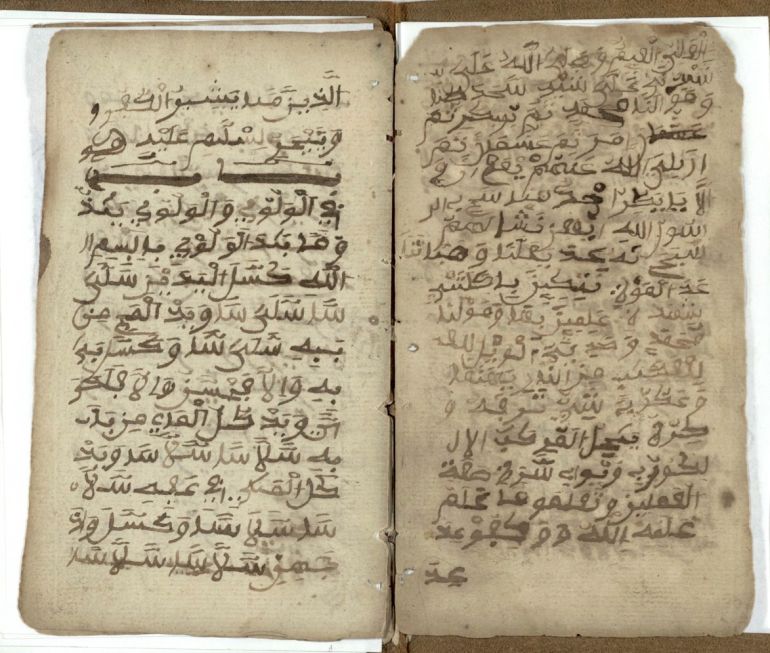
A page from a manuscript by Bilali, a Muslim from Guinea [Hargrett Rare Book and Manuscript Library, The University of Georgia Libraries]

The Muslims who became famous were only a handful but many others, as accomplished, remained nameless.

William Brown Hodgson, a former diplomat posted in North Africa and a slaveholder, stated in 1857: “There have been several educated Mohammedan slaves imported into the United States.”

In 1845, he informed the French Société d’ethnologie that “a Foulah prince, named Omar, is presently a slave in the United States and will be able to procure precious elements for a detailed notice on his nation.”

Hodgson had tried to get information – probably for the same purpose – from Muslims but had to stop due to slaveholders’ hostility.

Similarly, Theodore Dwight, the secretary of the American Ethnological Society, observed in 1871 that several Africans in different parts of the country were literate and he had “obtained some information from some of them”.

Unfortunately, he too encountered “insuperable difficulties in the way in slave countries, arising from the jealousy of masters, and other causes.”

Writing for freedom

Ayuba Suleyman Diallo made the most of his literacy. A trader and Quranic teacher from the Islamic State of Bundu in Senegal, he was abducted in 1730 in Gambia and sold to captain Stephen Pike of the Arabella.

Diallo told him his father would pay for his freedom and he was allowed to dispatch an acquaintance to his hometown. But the Arabella left before Diallo could be freed.

From Maryland, he wrote a letter to his father and gave it to a slave dealer with instructions to remit it to Pike. The letter did not reach him but ended up in London in the hands of James Oglethorpe, the deputy governor of the Royal African Company and future founder of Georgia. After reading the translation, Oglethorpe arranged for Diallo’s release and transportation to England.

The Senegalese arrived in London in April 1733. He met the royal family and helped renowned physician and naturalist Sir Hans Sloane  – whose private collection was the foundation of the British Museum, the British Library and the Natural History Museum – translate Arabic documents. Before returning to Bundu in July 1734, he posed for painter William Hoare and wrote three copies of the Quran from memory. One was sold in 2013 for 21,250 British pounds ($28,040) to the Dar El-Nimer Collection for Art & Culture in Beirut.

In Mississippi, Ibrahima abd al-Rahman followed in Diallo’s path with a letter he wrote in 1826. Thirty-eight years earlier the then 26-year-old son of the Muslim ruler of Futa Jallon in Guinea had been captured during a war. His letter was sent to Thomas Mullowny, the American consul in Morocco. He took it to Sultan Abd al-Rahman II, who asked for Ibrahima’s release. Secretary of State Henry Clay presented the case to President John Quincy Adams who devoted a passage to the matter in his diary on July 10, 1827.

After 39 years in Mississippi, Ibrahima was freed and left for Liberia in 1829 along with his American-born wife. He died shortly thereafter. Eight children and grandchildren were freed with the $3,500 he had raised for that purpose among abolitionists before leaving the US. They settled in Liberia, but seven relatives remained enslaved.
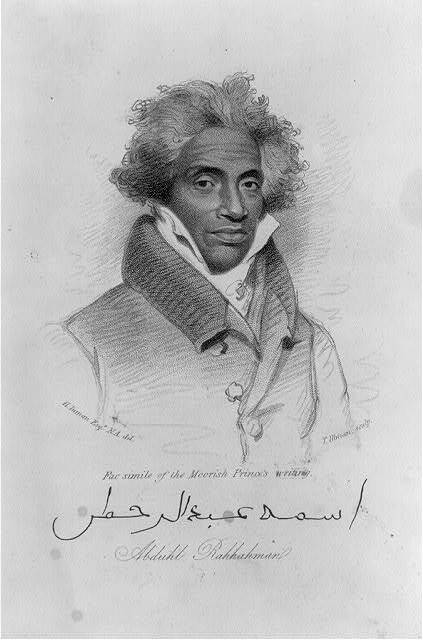
A portrait of Ibrahima Abd al-Rahman by Henry Inman [Library of Congress]

Challenging stereotypes

If his literacy didn’t free Omar ibn Said, it largely improved his situation. After he ran away in 1810 from an “evil man … an infidel who did not fear Allah”, Omar was captured as he prayed in a church and thrown in jail as a runaway. With pieces of coal, he covered the walls with pleas, in Arabic, to be released. The brother of a North Carolina governor bought him, gave him light tasks and furnished him with paper and Christian proselytisation.

Omar’s 1831 autobiography, written in Arabic, subtly denounced his enslavement with the help of Surat al-Mulk, which states that God has the power over all; in effect refuting his “owner’s” supremacy.

Professors Mbaye Bashir Lo at Duke and Carl Ernst at the  University of North Carolina at Chapel Hill have closely analysed his 17 known manuscripts. They found that he quoted from memory from a variety of works, including one by a 12th-century Andalusian Sufi master and a 16th-century Egyptian theological poem.

Much was made of Omar’s alleged conversion to Christianity and Francis Scott Key helped procure him a Bible in Arabic. Omar also had a Quran, which was said to be his most precious possession. Tellingly, his last known manuscript, in 1857, was Surat al-Nasr (the Victory) as in the victory of Islam against the “unbelievers” and other enemies. This was the last surah revealed to the Prophet Muhammad.

To be sure, the stereotype of Africans as uncivilised idolaters used as justification for their enslavement did not align with literate, monotheist people. Therefore, Muslims were often misrepresented as Arabs, Moors, and “descendants of the Arabian Mahomedans who migrated to Western Africa”.

The American Colonization Society, whose objective was to deport free Black people to Liberia, envisioned freed Muslims, like Ibrahima, as a conduit to the “civilising” of the continent and, strangely enough, its Christianisation.

The blues

The imprint of enslaved African Muslims can still be seen today. Arabic terminology survives in the Gullah language of South Carolina, in Trinidadian and Peruvian songs, in the Caribbean saraka, and in a variety of religions such as Candomble, Umbanda and Macumba in Brazil, Vodun in Haiti, and Regla Lucumi and Palo Mayombe in Cuba.

Moreover, a significant Muslim contribution, the blues, has been acknowledged by major musicologists since the 1970s. The roots of the blues can be found in the field holler – a solo, non-instrumental, slow tune with elongated words, pauses, and melisma, all constitutive elements of the Islamic style of singing and reciting.

What musicologists did not recognise, however, is that the holler was a direct product not of the Muslims’ memories, but of Islamic practices that endured in the US such as prayers, the recitation of the Quran, Sufi chants, and the adhan, the call to prayer.

In particular, the closeness to the adhan of WD “Bama” Stewart’s “Levee Camp Holler”, recorded in 1947 at Parchman prison in Mississippi, is quite extraordinary. When both are juxtaposed, it is hard to tell when one ends and the other starts.

The blues is one of the most lasting and overlooked contributions of African Muslims to American culture.

Another might be the ring shout of the American South, Jamaica, and Trinidad. A religious rite during which people turn in a circle, it was thought to be an African dance with a perplexing name since there is no shouting. Another explanation was proposed in the 1940s. One tour around the Ka’ba is called a shawt, which sounds close to the word “shout” in English. Like the pilgrims do in Mecca, the American shouters turn counterclockwise around a sacred structure, such as the church, the altar, or a dedicated second altar. Could Muslims have “reinvented” the major episode of the Hajj?

A forgotten history

Over time, the story and even the presence of African Muslims in the Americas faded from memory. But since the tragedy of 9/11, there has been a growing interest in this forgotten history, a stunning discovery to most.

African American Muslims used it to claim an ancient lineage and immigrant communities to show that Islam, far from being foreign, was as American as Christianity.

Today, people in the wider Islamic world are increasingly interested in this international history of Islam.

As Africans and as Muslims, the people who lived their faith in the dreadful oppression of American slavery contributed to the social, religious and cultural fabric of this country. The Muslims’ legacy, acknowledged or not, lives on. Their story is an African story, a Muslim story, and an American story.


MUCH OF REAL HISTORY IS HIDDEN OR MADE UP OF LIES!


BY DR. GERALD DIRKS

 White European US American born Dr. Gerald Dirks puzzled a deluded White RACIST European US American man when he saw Mr. Dirks with a long beard, and his wife wearing an ABAYA, the type made illegal in RACIST ZIONIST CHARLIE-HANUKAH FRANCE that also banned Muslim women decency – the wearing of a head scarf they call a “VEIL”!!!   


Muslims in American History - A Forgotten Legacy  2006

MuslimByChoice

97.8K subscribers 150,819 views 29 May 2009

What do you know about Muslim immigration to America?

When did the earliest Muslims arrive?

When did members of this community first arrive in America?

Dr Jerald Dirk received his Bachelor of Arts (philosophy) from Harvard College in 1971, his Master of Divinity from Harvard Divinity School in 1974, his Master of Arts (clinical child psychology) from the University of Denver in 1976, his Doctor of Psychology (Psy.D.) degree in clinical psychology from the University of Denver in 1978, and his sessions program certificate in Islamic studies from Imam Muhammad ibn Saud Islamic University in 1998.

In 1969, he obtained his License to Preach from the United Methodist Church and was ordained into the Christian ministry (deaconate) by the United Methodist Church in 1972.

 He embraced Islam in 1993 and completed the 'Umrah and Hajj in 1999.

 His vocational history includes over five years teaching in American colleges and universities and over 20 years spent in the private practice of psychotherapy. In addition, he has taught at the middle school level at two different private Islamic schools and has served as the psychoeducational consultant at one private Islamic school.

 Dr. Dirks is the author or co-author of over 60 published articles in the behavioral sciences (primarily in psychosomatic medicine), over 140 published articles on the Arabian horse and its history, and over 220 published articles or formal presentations on Islam, comparative religion, and private Islamic education in America.

 He has lectured widely on Islam at American universities (Tabor College, University of Kansas, University of Denver, Oklahoma State University, Missouri State University, Wayne State University, University of Michigan, University of Pittsburgh, University of Alabama at Birmingham, and Georgetown University), in American mosques (in Arizona, California, Colorado, Georgia, Illinois, Kansas, Michigan, New York, Oklahoma, Pennsylvania, Tennessee, Texas, Utah, and Virginia), and at regional and national conventions of the major Islamic organizations (ISNA, ICNA, and MAS).

 In addition, he has been interviewed about Islam by newspapers in California, Colorado, Missouri, and Occupied Saudi Arabia and by television stations in Kansas, New York, Texas, Utah, Canada, and the United Arab Emirates.

 He is the author of four books that explore the commonalities and differences among the three Abrahamic religions (Islam, Christianity, and Judaism): The Cross and the Crescent, now in its second printing; Abraham, The Friend of God; Understanding Islam--A Guide for the Judaeo-Christian Reader; and The Abrahamic Faiths--Judaism, Christianity, and Islam.

 His fifth book, Muslims in American History--A Forgotten Legacy was published in 2006 and celebrates the centuries-old history of Muslims in America.

 His sixth book, Letters to My Elders in Islam, was published in 2008. Dr. Dirks has also proofread and/or edited several books for other authors.

 The Topic: Muslims in American History: A Forgotten Legacy A talk by Dr Jerald Dirks http://www.dirksonlinebooks.com/


Sunday, 3 December 2023

TRUE ISRAEL OF GOD, PASTOR DOUGLAS WILSON, ANTISEMITISM, Jonas E. Alexis, Senior Editor of Veterans Today.


Churchianity’s Support for Israeli Genocide and “Cheers for the Talmud”

Analyzing Douglas Wilson’s new book, “Antisemitism, the Promise of Deuteronomy, and the True Israel of God”

0
1022

VT Condemns the ETHNIC CLEANSING OF PALESTINIANS by USA/Israel

$ 280 BILLION US TAXPAYER DOLLARS INVESTED since 1948 in US/Israeli Ethnic Cleansing and Occupation Operation; $ 150B direct "aid" and $ 130B in "Offense" contracts
Source: Embassy of Israel, Washington, D.C. and US Department of State.

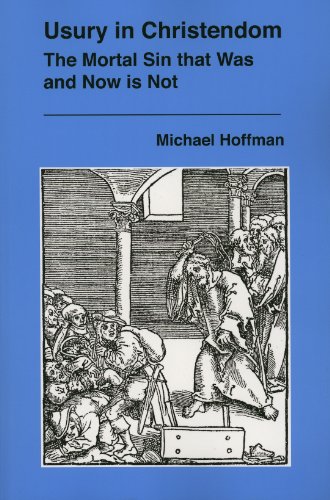
By Michael Hoffman, editor of Revisionist History

American Milk and Honey: Antisemitism, the Promise of Deuteronomy, and the True Israel of God
By Douglas Wilson
Canon Press, 2023, 236 pages

Douglas Wilson, the prominent pastor of Christ Church, is almost always by turns provocative, brilliant, infuriating, dead wrong and plain right. This influential Calvinist (“Reformed”) theologian writes, lectures and broadcasts in a Geneva-like citadel in the north Idaho town of Moscow, where Christian conservative institutes and families have arisen like fields of sunflowers. He writes a lively blog at https://dougwils.com/

His Canon Press this month published American Milk and Honey, provocatively subtitled “Antisemitism, the Promise of Deuteronomy, and the True Israel of God.” It contains facts which radically undercut some of the reigning orthodoxies of evangelical and conservative Protestantism; and Wilson being Wilson, makes other assertions which radically undercut his radical undercutting.


In the early pages of the book he writes, “I am a supercessionist, a doctrine which holds that the promises given to Israel in the Old Testament have been fulfilled in the New Israel, which is the Christian church. The Greek word Iudaios can be rendered either as ‘Jew’ (as opposed to Gentiles), or as ‘Judean,’ as opposed to Galilean…

“… because there is no salvation apart from Christ, modern Jews, who reject Christ as their Messiah, are rejecting their only possible hope of salvation. I am not a Zionist, Christian, or otherwise, which means I don’t believe there was a theological case to be made for the establishment of Israel and Palestine in 1948… I believe that the Holocaust was a horrific evil, but I don’t believe it sui generis—the human race has it been every bit as wicked as that before, and on numerous occasions.”

The preceding two paragraphs are, in our post-modernist 21st century, burn-‘em-at-the-stake heresies, and if that form of capital punishment were still around Rev. Mr. Wilson would be consigned to the flames, which tells us that his book is not for the mainstream or the Establishment. It is for a minority in America, though a substantial—and in the Republican party—significant one; this minority being Right-wing Protestant Christendom.

Let’s call the author’s paragraphs the “Three Theses.” He has nailed them to the door of the Church. They contain points which, as Elvis stated in one of his hit songs, are “guaranteed to blow your mind,” or at least the minds of Franklin Graham, Mike Pence, Ron DeSantis, Jonathan Greenblatt and their minions: 1. The Church is Israel Now. 2. God did not establish “the State of Israel” in Palestine. 3. There were many holocausts in history, not just one.

Having asserted these chili pepper-hot dissents, none of which would have been particularly controversial in Christianity a century ago, Douglas Wilson is hereafter unlikely to be invited to lecture at the Pontifical Academy in Rome, the Israeli Yad Vashem Holocaust Museum, the Billy Graham Evangelistic Association, or the numerous Scofield Dispensationalist mega-churches that dot the map of America.

Israeli Propaganda 101

Then tragedy strikes. After he affirms the preceding courageous truths, Dr. Jekyll morphs into Mr. Hyde. It pains me to say this, given my esteem (as I wrote at length in our review of his book Mere Christendom, “Christian Nationalism: Blessing or Menace?”).

In view of the datum that he is emerging on the national scene as the pre-eminent theologian of a muscular, masculine faith that harkens to the roots of our nation at Plymouth Rock and Lexington and Concord, we ignore his serious misdirection in American Milk and Honey at our peril.

I’m distressed and confounded by that fact that a man of Wilson’s luminous vision and intellect would sketch a history of Palestine which is a gullible regurgitation of Israeli Propaganda 101, exhibiting no healthy skepticism of Zionist axioms, and little or no familiarity with indispensable histories by eminent Judaic scholars such as Ilan Pappé, Noam Chomsky, Richard Falk, Rabbi Yaakov Shapiro, Norman Finkelstein and Alfred Lilienthal. We get a reference to militant Zionist Dennis Prager and zero reference to a little incident known as the Nakba, when 700,000 Palestinians were expelled from their ancestral lands and thousands were murdered by terrorists commanded by future Israeli Prime Ministers Begin and Shamir.

Pastor Wilson accepts without question the Israeli hasbara endlessly parroted in the U.S. that the Palestinians were offered a viable, independent state of their own and those “terrorists” rejected this Zionist munificence. Wilson writes: “In the year 2000, they (Israel) offered the Palestinians their own state, including Gaza, and 95% of the West Bank. But the Palestinian leadership rejected the offer, and sent waves of terrorists into Israel.”

Pastor Wilson is referring to the Oslo Accords. The documentary record is as follows: the Israeli government issued a diktat that the Palestinians were “to accept unconditionally its peace program: the creation of a demilitarized Bantustan without independent foreign or economic policy, and without the huge settlement blocks in Gaza, the greater Jerusalem area, the Hebron mountains, or the Jordan Valley.”

In return for this radically reduced concept of “Palestine,” the Palestinian leadership “was asked to declare the end of the conflict and the end of all its previous demands, including the right of the (hundreds of thousands of displaced) Palestinian refugees to return to their homes. Needless to say, the future of the Palestinians in Israel was not part of the program.” (Cf. Pappé, The Forgotten Palestinians: A History [Yale University Press, 2011], pp. 221-222).

The founding human rights principle of the Israeli state is The Right of Return of the Jews to their Biblical Homeland. But “the right of return” is also sacred to Palestinians. On this point enter the realm of Talmudic supremacism’s race dogma, where rights claimed by Arabs are diminished and denied due to their status as “lesser souled” beings (BT Sanhedrin 57a; Bava Kamma 113, Bava Metzia 24A).

In the Tanya of Shneur Zalman of Lyady we encounter the doctrine that the souls of the gentiles contain no good whatsoever, as it is written in the Etz Chayim, which teaches that…all the good which the gentiles do is from self-serving, egotistical motives and as such this apparent good is actually a type of sin.”

Tanya Likutei Amarim I: ‘This law law is taught: in the case of Israel, this soul of the kelipah is derived from kelipat nogah, which also contains good, as it originates in the esoteric ‘Tree of Knowledge of Good and Evil.’ The souls of the nations of the world (gentiles) however, emanate from the other, unclean kelipot which contain no good whatever, as is written in Etz Chayim, 49: 3, that all the good that the nations do, is done from selfish motives. So the Gemara comments on the verse, ‘The kindness of the nations is sin,’— all the charity and kindness done by the nations of the world is only for their own self-glorification.”

It is important to place this ghastly dogma in context. First, the majority of Jews in the world have no idea that these teachings exist and if they did they would repudiate them. Anyone who would use the facts in the preceding paragraph to negatively stereotype a majority of the Judaic people of the world would be guilty of propagating a type of collective hatred without exception, which is what we see aimed at the people of Gaza by the Zionists. Researchers and activists of integrity should make precise distinctions and eschew generalizations.

Second, the contempt for gentiles in the Talmud of Babylon and successive sacred halachic volumes was, in general, not often acted upon, and did not constitute a praxis until it was weaponized by Zionism.

It is Zionist-Talmudism that now predominates in the Knesset (Israeli legislature). We elucidated the perimeters Talmudism before and after Zionism in our study, “The Disaster of Israeli Zionism: The Cryptocracy’s Covert Stratagem for the Destruction of the Jewish People.”

In light of the fact that the Palestinians are subjugated by a Zionism which has reanimated once dormant Talmudic injunctions, how likely is it that the Palestinians will receive fair treatment at the hands of the Israeli government?

Any peace treaty, the Palestinians insist, must include a Law of Return for Palestinian refugees: “It has remained their fundamental objective since 1948. Their determination on the return issue has endured despite warfare, suffering, an enormous, social, and political changes.” (Ibid., Pappé).

Wilson, relying on the paint-by number “history” served up by Dennis Prager and other polemicists posing as historians, expects the Palestinians to forfeit that which Israelis hold sacred. This is the Talmudic double-standard which the Palestinians were right to reject. They too seek a Right of Return. Why not?

I cringe at Right-wing Christendom’s implicit naiveté, which holds that the Israelis made an honest, good faith offer to the Palestinians which the Israelis firmly intended to uphold; that claim is a sinister joke.

Every government of any nation lies and breaks its word on occasion; it’s a given. Yet, for the Israelis, deceiving and breaking agreements is the default method of conducting relations with the subjugated Palestinians. Does Wilson factor this fact into the history at hand? He discredits his thesis by failing to do so.

As a representative example of the long history of institutionalized mendacity and deception, let’s examine the outrageous lie told by Israeli Prime Minister David Ben-Gurion (born David Grün in Russian Poland) a founding father of the Israeli state, concerning a 1953 massacre by the Israeli military. On August 5, 1953 Ariel Sharon was placed in command of military Unit 101, tasked with terrorizing Arab civilians into fleeing Palestine. On October 14 troops from Sharon’s Unit 101 bombed and shot up the Palestinian village of Qibya. At least sixty Palestinian men, women and children were massacred. There were no Israeli casualties.

Israeli historian Benny Morris writes: “Sharon and the IDF (Israeli armed forces) subsequently claimed the villagers had hidden in sellers and attics, and the troops have been unaware of this when they blew up the buildings. But in truth, the troops had moved from house to house, firing through windows and doorways, and Jordanian pathologists reported that most of the dead had been killed by bullets and shrapnel rather than by falling masonry or explosions. In any event, the operational orders from (Israeli) CO central command to the units involved, dated October 13, had explicitly ordered ‘destruction and maximum killing.

“…On October 19 Ben Gurion went on the air with a wholly fictitious account of what had happened… ‘we have carried out a searching investigation, and it is clear beyond doubt that not a single army unit was absent from its base on the night of the attack on Qibya.’ But everyone understood that the military was responsible, and that the operation had been authorized by the government.” (Benny Morris, Righteous Victims: A History of the Zionist-Arab conflict, 1881–1999 [New York, 1999, pp. 278-279; italics added).

“Systematic Israeli prevarication”

“The Palestinian claim that Israel refuses to implement signed agreements and violates its commitments in various other ways is beyond dispute. A simple comparison of the September 1993 declaration of principles (“Oslo”), the September 1995 Interim Agreement, (Oslo II), the January 1997 Hebron Protocol, the October 1998 Wye River Memorandum, and the September 1999 Sharm el Sheikh agreement, reveals a clear pattern in which Israel first refuses to implement its own commitments, seeks and obtains their dilution in a new agreement, subsequently engages in systematic prevarication, and finally demands additional negotiations, leading to a yet further diluted agreement. (Cf. Mouin Rabbani, The New Intifada [2001], pp. 72-78).

Despite the cynical realpolitik involved, Wilson swallows whole the Israeli line with the utopian credulity of a grammar school choir boy: “the Palestinian leadership…could have a Palestinian state tomorrow (not counting Jordan, which already is a Palestinian state), if they would simply acknowledge Israel’s right to exist, and agree to live in peace.”

Zionist deceit and denial related to the Israeli Attack on the USS Liberty

Douglas Wilson is a Navy veteran who, with no qualms or doubts, asserts his complete faith in the Israeli allegation that they offered a genuine and generous peace deal to the Palestinians. He doesn’t ask how a government that massacred American sailors and then lied and deceived for decades concerning the atrocity, would prove an honest broker for peace with the Palestinians.

The Israeli account of their deliberate bombing and strafing of the US Navy ship Liberty in 1967, killing 34 American sailors and wounding 173, consists of outrageous lies and disinformation. According to the testimony of Admiral Thomas Moorer, former Chairman of the Joint Chiefs of Staff, “the Israeli air attack lasted approximately 25 minutes, during which time unmarked Israeli aircraft dropped napalm canisters on USS Liberty’s bridge, and fired 30mm cannons and rockets into our ship, causing 821 holes, more than 100 of which were rocket-size; survivors estimate 30 or more sorties were flown over the ship by a minimum of 12 attacking Israeli planes which were jamming all five American emergency radio channels.

“…the torpedo boat attack involved not only the firing of torpedoes, but the machine-gunning of Liberty’s firefighters and stretcher-bearers as they struggled to save their ship and crew; the Israeli torpedo boats later returned to machine-gun at close range three of the Liberty’s life rafts that had been lowered into the water by survivors to rescue the most seriously wounded…there is compelling evidence that Israel’s attack was a deliberate attempt to destroy an American ship and kill her entire crew…That in attacking USS Liberty, Israel committed acts of murder against American servicemen and an act of war against the United States.”

What chance does Rev. Wilson think the Palestinians have in finding an honest partner for peace, when Israelis committed an act of war against their own American “ally” and have attempted to fool the world about it for 56 years?

Dissimulation and prevarication are permitted by Talmudic halacha (BT Yevamot 65b, Bava Kamma 113a, Sanhedrin 11a; also cf. Judaism Discovered, pp. 595-608).

In studying the texts at length one discovers a process of legitimating the expansion of grounds for prevarication and duplicity. The permission to lie creates an ever larger body of precedent for ever more situations under which falsehoods are sanctioned. The Tosafot on Baba Metvia 23b states that “all permitted lies are really subsets of one sweeping permission found in Yevamot 65b.”

12,000 Palestinian civilians murdered in a matter of weeks but Churchianity has it that Israel “is constrained by just war theory”

Wilson further discredits his argument by making the evidence-free, indeed completely bonkers observation that Israel “is constrained by just war theory.” As Jonathan Cook notes, “even when Israel commits crimes against humanity in broad daylight…Western establishments still refuse to acknowledge those crimes…”

I’m reading Pastor Wilson’s mind-boggling assertion in the wake of the 12,000 Palestinians murdered in October-November of this year, as collective punishment for what Hamas terrorists perpetrated on October 7:

“As of November 25, in less than two months, more than twice as many women and children have been reported killed in Gaza by Israeli forces than in Ukraine after two years of war.

“…the pace of death during Israel’s campaign has few precedents in this century. People are being killed in Gaza more quickly, they say, than in even the deadliest moments of U.S.-led attacks in Iraq, Syria and Afghanistan…Israel’s liberal use of very large weapons in dense urban areas, including U.S.-made 2,000-pound bombs that can flatten an apartment tower, is surprising, some experts say…

“In one documented case, Israel used at least two 2,000-pound bombs during an Oct. 31 airstrike on Jabaliya, a densely populated area just north of Gaza City, flattening buildings and creating impact craters 40 feet wide, according to an analysis of satellite images, photos and videos by The New York Times. Airwars independently confirmed that at least 126 civilians were killed, more than half of them children…

“It’s beyond anything that I’ve seen in my career,’ said Marc Garlasco…a former senior intelligence analyst at the Pentagon. To find a historical comparison for so many large bombs in such a small area, he said, we may ‘have to go back to Vietnam, or the Second World War.’…More than twice as many women and children have already been reported killed in Gaza than in Ukraine after almost two years of Russian attacks, according to United Nations estimates….Women and children account for nearly 70 percent of all deaths reported in Gaza…More than 60,000 buildings have been damaged or destroyed in the Gaza Strip, satellite analysis indicates…

“Every day, local journalists in Gaza report strikes that hit private homes, some of which kill a dozen or more people as families shelter together in tight quarters. On Oct. 19, Israel struck a Greek Orthodox church where hundreds of Gaza’s small Christian community were sheltering at dinnertime, killing 18 civilians, according to an investigation by Amnesty International.” Source: “Gaza Civilians, Under Israeli Barrage, Are Being Killed at Historic Pace,” New York Times, Nov. 25. 2023.

If this is “just war theory” in action, I would hate to see what an unjust war would look like.

We are fighting human animals, and we are acting accordingly,” said Yoav Gallant, the Israeli defense minister. “You must remember what Amalek has done to you, says our Holy Bible — we do remember,” said Prime Minister Benjamin Netanyahu, referring to the ancient enemy of the Israelites in scripture, representing a call to exterminate their “men and women, children and infants.”

Hate speech used to describe the Palestinian people by journalists, retired generals, celebrities, and social media influencers has proliferated. Calls for Gaza to be “flattened,” “erased” or “destroyed” have been mentioned about 18,000 times since Oct. 7 in Hebrew posts on X, the site formerly known as Twitter. The cumulative effect has been to normalize genocide—talk of “erasing” the people of Gaza and the nuclear annihilation of the Arab people. In early November Amichay Eliyahu, an Israeli official, told an Israeli radio station that there is no such thing as noncombatants in Gaza. He advocated that the Israeli military drop a nuclear bomb on the territory.

Eyal Golan, a star of the Israeli pop music scene, stated in a TV interview with Israeli Channel 14, “Erase Gaza. Don’t leave a single person there.”

In a radio interview in October, Israel’s First Lady, Sara Netanyahu, said in regard to the Palestinians, “I don’t call them human animals because that would be insulting to animals.”

Israeli war crimes in Gaza justified by invoking the mass killing of Japanese and German civilians in World War II

Similar rhetorical points have been made by other Israeli leaders and influencers as justification for the Israeli bombing of civilians in Gaza, including references to the indiscriminate Allied firebombing of civilians in Tokyo and Dresden ordered by Churchill and Franklin Roosevelt during World War II.

“It became evident to U.S. officials that Israeli leaders believed mass civilian casualties were an acceptable price in the military campaign. In private conversations with American counterparts, Israeli officials referred to how the United States and other allied powers resorted to devastating bombings in Germany and Japan during World War II…” (New York Times, October 31, 2023, p. A1).

Just war theory requires the Israelis to enter Gaza, overcome and apprehend Hamas fighters, take them as prisoners of war and try them according to the rules of war, rather than incinerating and flattening entire cities packed with women and children, acts which constitute state terrorism and war crimes.

In this regard Rev. Wilson appears to be clueless, along with millions of viewers of Fox News and CNN.

The Israelis killed 20,000 Arab civilians in indiscriminate bombings in Beirut, Lebanon throughout the summer of 1982, culminating in massive terror bombings in August. How can anyone reconcile that holocaust with “just war theory”?

We are entering a twilight zone of the surreal where facts have no impact on confirmation bias. Right wing Churchianity has a psychological need to “stand with Israel,” no matter the reality of the unconscionable Israeli slaughter of the innocent.

Corporate America boycotts Elon Musk’s “X” social media due to his alleged “antisemitism,” while their flagship Wall Street Journal publishes hate speech against civilians in Gaza, with no adverse consequences for the Journal. Major corporations continue to advertise heedless of the anti-Arab bigotry. In the November 17 Journal (p. A14), we were told that the people of Gaza as a whole are filled with “hatred” and “disinformation.”

Become a paid subscriber

In the same issue, Tony Badran, News editor of Tablet Magazine, wrote: The “proposal that America and other Western nations take in tens of thousands of refugees from Gaza is sheer lunacy…America cannot and should not accept more people from sick societies, never mind likely terror supporters and anti-Semites.” From these remarks we glimpse the insinuation that Palestinian civilians are collectively spiritually and psychologically “sick…anti-semites.” This hate speech has real world consequences, which is one reason we have taken Wilson to task at length. Conservative Christians continue to join the US military in higher numbers than the general population, often serving overseas. Pastor Wilson’s readership includes present and future members of the armed forces who are likely to be dutiful servants of war Zionism as a consequence.

In Pastor Wilson’s section on the Babylonian Talmud, he verifies— by either quoting from or alluding to—a few of the most heinous and despicable portions of the Talmud, whose existence for centuries has been denied. He omits some of the worst (the teaching that Jesus was a magician who deserved to be killed, and that the mother of Jesus was a harlot). Nonetheless, at first glance it looks as though it required considerable testicular fortitude for him to address these forbidden facts in print.

And yet, in retrospect, his revelations almost appear to be—I hope I’m wrong—a form of damage control. Is this the case—conceding as authentic what researchers such as this writer have documented about the contents of the Talmud, and then proceeding to muddy the waters? More harrowing, he actually gives qualified praise to the Talmud, and even makes a case for the Pharisees.

“Two Cheers for the Talmud”

In a section he titles, “Two Cheers for the Talmud,” he suggests it contains knowledge as valuable as “gold and silver.” Later he asks, “…what can we say in favor of the Talmud”? To which a Socratic interlocutor might reply, Why do you feel the need to say anything in its favor?

According to the denotation of the word “favor,” Wilson is asking what there is in the Talmud of which a Christian may approve. This writer has read thousands of pages of the Mishnah, Gemara, MidrashZoharMishneh Torah, Shulchan Aruch, Tanya, Mishnah Berurah, Kitzur Shulchan Aruch, and other sacred volumes at the level o f pshat, remez, derush and s od, cognizant of the exegetical tools of middot and gezera shava. These comprise a gigantic heap of self-perpetuating legal and textual arcana.

There would be entertainment value in the surfeit of crazed rules and minutiae were it not for the lamentable fact that they are employed to oppress the Judaic people who are in thrall to them: the countless laws micromanaging how to wash the dishes, sweep the floor, sleep, nap, urinate, the holy way to defecate, the demons that dwell in the outhouse and how to avoid them, the rabbis who successfully make a cow using magic, and myriad other trivialities and hooey which nonetheless have the force of law.

There is also horror, like the numerous statements of extreme misogyny—for instance, likening women sexually to “meat” (BT Nedarim 20a): “Whatever a man wishes to do with his wife he may do. He may engage in sexual intercourse with her in any manner that he wishes, and need not concern himself with restrictions. She is like meat that comes from the butcher.” Women are “sacks of excrement” (BT Shabbat 152b).

Let’s not overlook the halachos of Niddah which resulted in endless hours on Sigmund Freud’s psychiatric couch in Vienna, as women under the suzerainty of the Talmud attempted to free themselves of the curses applied to them if they violated its man-made laws on menstruation. Then there is the abrogation of God’s solemn command that all debts were to end in seven years, as well as the untold misery resulting from the Talmudic teaching that black people are forever destined to be hereditary slaves (BT Sanhedrin 108b), as result of Ham allegedly having sodomized Noah on board the ark (BT Sanhedrin 70a).

“Two cheers for the Talmud”? How about none?

In the midst of thousands of pages of spiritually dead detritus, Rev. Wilson minimizes it and announces that—get ready for it—thanks to Messiah ben Joseph, a book by David Mitchell, which we are “urged to consult,” we can indeed approve of the Talmud in a limited way:

“Mitchell’s book is a work of dense scholarship…it is rich. And an essential part of the richness is seen in how it displays the meticulous and detailed knowledge of the text of scripture displayed by the rabbis.”

So what? In Matthew 4:6, Satan himself quotes Psalm 91: “He will command his angels concerning you, and they will lift you up in their hands, so that you will not strike your foot against a stone.” In ages past it was common knowledge that “The devil can cite Scripture for his purpose” (Merchant of Venice, Act 1, Scene 3).

Most Christians who have been led to believe the Talmud offers wise insights into the Bible, have little familiarity with the actual contents of the Talmud. If they were aware that it teaches blasphemy against the holy name of Jesus, Christians would condemn it unequivocally. Douglas Wilson, who is not ignorant in this regard, likens portions of the Talmud to gold, silver and “treasure,” and suggests that we offer qualified cheers for it. The recklessness of his misdirection is breath-taking.

Jesus complimented the Pharisees — sort of

He does something similar on behalf of the Pharisees: he upholds the monotonous propaganda that is all too familiar to those who have for years been in this struggle with both papal and Protestant Churchianity. He writes that Jesus gave the Pharisees a “back-handed compliment” with Christ’s reference to the Pharisees being in the judgement seat of Moses—after which Jesus says, “Whatsoever they bid you, observe.” (Matthew 23: 2-3).

What exactly is complimentary about this statement of fact by Jesus? In the note on this passage in the English Standard Version (ESV) Study Bible we read, “Jesus recognized the Pharisees’ official function as interpreters of the law of Moses, and in so far as they accurately interpreted scripture, they were to be obeyed. However, ‘so’ (Gr. oun) connects this verse with verse 2, and the mention of Moses, and therefore, ‘whatever they tell you’ should probably be limited to ‘whatever they tell you about the law of Moses,’ and does not include the Pharisees’ later extensive additions to Mosaic laws which rabbinic teachers made… Jesus is about to show that much of the Pharisees’ practice and their extra-biblical tradition is wrong.”

Rev. Wilson’s confusion is evident in his hair-splitting comment on this passage in Matthew 23: 2-3. He writes, “Christ was closer doctrinally to the Pharisees than he was to the Sadducees.” Yeah, and the earth is closer to the planet Uranus than galaxy GN-z11, but earth is still 1.7 billion miles from Uranus, and Jesus was a billion miles distant spiritually and theologically from the Pharisees, with whom He shared no doctrinal relationship, not even relatively. When the Pharisees spoke the doctrine of Moses from the seat of Moses, needless to say it was Mosaic, not Pharisaic.

The doctrine of the Pharisees, whether contrasted with the Sadducees or not, consisted of their own extra-biblical traditions. It is a serious error to assert that Jesus in some way, shape or form was “close” to traditions which comprised doctrines “which nullify the word of God” (Mark 7).

In Luke 12:1 our Lord describes those doctrines as the “leaven of the Pharisees.” What did He mean? How does leaven work? Silently; the smallest particle of it when spread to other dough, will ferment the whole of it. What then is Jesus warning of? He was exhorting us to beware of the smallest particle of the doctrine of the Pharisees, lest it infect the whole of the community of believers.

For some reason, Jesus’ famous “woes,” issued to the Pharisees, are reduced by Rev. Wilson solely to what he terms Christ’s “fierce denunciations of pietistic and scrupulous folly.” Pietism and scrupulosity were the main sins worth mentioning in regard to the Pharisees?

Wilson’s creampuff distillation belies one of the most serious charges which Jesus famously laid against them in Matthew 23:15: “Woe unto you, scribes and Pharisees, hypocrites! for ye compass sea and land to make one proselyte, and when he is made, ye make him twofold more the child of hell than yourselves.”

Charging them with being the children of hell would seem to be a trifle more exigent than assessing them as overly-scrupulous pietists. It is a momentous warning concerning what the Pharisees represent in the essence of their theology. Why did Rev. Wilson omit it?

St. Paul was honored to have been a Pharisee — sort of

As if his pro-Pharisee rationalization about Jesus was not enough, Pastor Wilson’s vague connection between the views of Jesus and those of the Pharisees leads on toward his suggestion of St. Paul’s alleged lingering esteem for his past association with them. Wilson’s hint is just nebulous enough to have us attempting to nail jello to the wall in trying to determine what exactly Wilson is denoting.

What he’s connoting however is visible. Rev. Wilson endeavors to find something favorable to the Pharisees in St. Paul’s declaration in Acts 23:6, about which Pastor Wilson states, “… the apostle Paul was trained as a Pharisee under Gamaliel, and even after his conversion, was willing to still identify himself in that way: before the Sanhedrin he cried out that he was a Pharisee, the son of Pharisees, and that he was on trial, because of his belief in the resurrection of the dead.”

As a bald restatement of a scripture verse, Wilson’s reference to Acts 23:6 is of course not objectionable. But within the context of his over-arching notion of Jesus paying a compliment to the Pharisees, it lends itself to the fantasy that Paul did so as well. In Churchianity this is a favorite bit of what Mencken would have termed buncombe. For example, in Pope John Paul II’s 1985 document, “Vatican Commission for Religious Relations with the Jews,” we read, “Paul…always considered his membership of the Pharisees as a title of honor.”

In Acts 21-23 Paul is facing a violent Jewish mob and a Sanhedrin that seeks to kill him. He identifies himself as a Pharisee as a divide-and-conquer tactic in order to sow discord between the Sadducees and the Pharisees. The passage, when taken in context (Acts 23:6-7) reveals this: “Now when Paul perceived that one part were Sadducees and the other Pharisees, he cried out in the council, ‘Brothers, I am a Pharisee, a son of Pharisees. It is with respect to the hope and the resurrection of the dead that I am on trial.’ And when he had said this, a dissension arose between the Pharisees and the Sadducees, and the assembly was divided.”

Nowhere does Scripture denote, suggest or imply that Paul considers the title of Pharisee to be in any way benevolent. Reading from Acts 21:17 through to Acts 23:35 we see that St. Paul is not relaxing on a seaside veranda teaching disciples while at his ease. He is in peril of his life. Nonetheless, no matter what duress he is under, Paul’s intention is not to deceive anyone by his statement. Rather, he is humbly informing the threatening, violence-prone Pharisees that, as you are now, I once was. In his public confession in Acts 22:3-5, he convicts himself of Pharisaic crimes: “I am a Jew, born in Tarsus in Cilicia, but brought up in this city, educated at the feet of Gamaliel according to the strict manner of the law of our fathers, being zealous for God as all of you are this day. I persecuted this Way to the death, binding and delivering to prison both men and women, as the high priest and the whole council of elders can bear me witness.”

Does Rev. Wilson expect us to believe that the Apostle Paul regards it as some kind of recommendation that as a Pharisee he “persecuted to death” those of the “Way” (of Christ)? St. Paul’s statement in Acts 23:6 that, “I am a Pharisee” must be read in the context of his statement that precedes it in Acts 22:20: “And when the blood of Stephen your witness was being shed, I myself was standing by and approving and watching over the garments of those who killed him.” Where is Paul indicating there is anything good about a Pharisee?

In these passages the apostle is addressing the Judaizers in the Church, attempting to persuade them of the errors of their ways. He is making his statement not on the basis of the proposition that he was showing forth the merit of being a Pharisee, but to demonstrate that in opposing the Pharisaic Judaizing of the ecclesia of Christ, he himself did not lack a Pharisee pedigree.

Ashkenazic Jews are really gentiles—no, wait—they’re “natural branches”—no, wait—they’re the covenant people—unless their covenant is with Ishmael, no, wait…

The author of American Milk and Honey descends into incoherence when he raises the issue of Jews and racial lineage. He mentions in a footnote, “It is often said that Ashkenazi Jews are not Jews at all, and that there is not a drop of Abraham’s blood in their veins. And so it is maintained that this is all a lot of fuss and bother over a bunch of nothing. ‘A gift is not irrevocable if it was never given.”

In other words Ashekenazic Jews are gentiles. He does not say that he believes this, only that it’s a common assertion. He then proceeds to drop the following bombshell: “This overlooks the fact that being a Jew was always about covenant and not about DNA.”

What happens to the statement that “God loves the Jews for the sake of their fathers” if they are actually not Jews?

There are no more race-obsessed books on planet earth than the volumes of the Talmud, and no more assiduous genealogy-trackers than many Talmudists, who have made one’s yichus a key to rabbinic position and claims to authority. Moreover, marriage to a highly desirable spouse in orthodox Judaism is predicated on one’s lineage, as almost any shidduch knows.

This Talmudic obsession is also a consuming passion of Dispensational Protestantism, which has built its theology upon the belief that the Ashkenazic and Khazar European-descended Judaics are indeed the direct genetic descendants of Abraham, Isaac and Jacob. Wilson, en passant, suggests (sort of) that maybe they are not. In which case, no problem. He opines, “It will be a piece of cake for God to graft them into the olive tree again.”

He adds as an afterthought, “He can graft in anybody—especially the natural branches (Romans 11:24, italics added).”

So the Ashkenzai are genetically (naturally) Jews after all? Go figure.

Then there’s this from chapter 8: “Although the ethnic Jews are descended from Abraham physically, covenantally speaking, they are Ishmaelites. Summed up, they are in a covenant of bondage.” What happened to the statement that “being a Jew was always about covenant”?

He puts the finishing touch on this farrago in his Glossary, where he quotes from the December 2022 statement of the Calvinist “Knox Presbytery” (Communion of Reformed Evangelical Churches), of which the church he pastors is a member:

“A common assertion among antisemites is that the Ashkenazi Jews converted to Judaism a number of centuries after Christ, and thus, there is not a drop of Abraham’s blood in their veins.”

A common assertion among antisemites? There’s an alarming insinuation in that statement, which appears to have been lifted verbatim from ADL purple prose, that only antisemites believe that the Ashkenazi are not genetic descendants of the Old Testament patriarchs, and respectable scientists and ethnographers all reject the claim. Here we’re observing that which transforms an otherwise generally decent and intrepid Communion of Reformed Evangelical Churches, into a pusillanimous outpost of Churchianity.

Do these churchmen actually believe it is usually “antisemitic” to offer a dissenting genetic or ethnographic opinion? If not, they should have said as much. Otherwise, it’s about as “woke” as it gets. Israeli genetic scientist Dr. Eran Elhaik, linguist Paul Wexler and Jewish man of letters Arthur Koestler are all suspect antisemites? Should these leaders in science, philology and literature who are motivated by a pursuit of the truth, be libeled in this fashion? It smacks of false witness and politically correct pandering to the delusions of the thought police.

Moreover, in his chapter on “American Exceptionalism” Wilson writes, “Britain used her military prowess at sea to suppress the slave trade, and so she was chosen for that.” He neglects to mention the fact that England’s Navy was among the first to put the trans-Atlantic slave trade on a firm basis, with Protestant heroine Queen Elizabeth I a heavy investor, and recipient of the wealth gained from the traffic in African flesh, which her pirates Hawkins and Drake obtained on her behalf. It looks as though “she was chosen for that” too.

There are welcome insights in Rev. Wilson’s American Milk and Honey, such as his review of the salvation of gentiles in the Old Testament (in the digital Kindle edition at 1026, 1043, 1061 1079, 1113, 1131, 1149). Unfortunately, at 1201 he makes reference to the “Shekinah glory” in Jerusalem. There’s no such word Shekinah in the Bible. It’s an allusion to a female Kabbalistic deity; it is unfortunate to see it employed by a sola Scriptura exegete.

Douglas Wilson has been in the past a man for all seasons: a tireless educator, school, church and college founder, sagacious marriage counselor, scholar, author, wit and thorn in the side of the COVID cops when he hosted a public psalm-singing in downtown Moscow without the singers being masked, in defiance of a local Idaho ordinance. Some of his congregants were arrested.

The town of Moscow is bursting at the seams with hopeful, conservative Christian families. Much of the thanks are due to Douglas Wilson and his associates. Many of his Biblical seminars and homilies are instructive and edifying, enlivened by his merry wit.

In the face of the contents of American Milk and Honey, we are led to wonder whether his fine accomplishments of the past have somehow become subordinate to a qualified rehabilitation of the Talmud, and support for Israeli war criminals in the face of overwhelming evidence of their atrocities. While we acknowledge Wilson’s tremendous achievements, we respect him enough to protest and call for a return to his high standards.

Writing this review has been more of a duty than a joy. It is offered in a spirit of assistance to Pastor Wilson—extending to him the benefit of the doubt that his cheers for the Talmud of Mystery Babylon and war Zionism, are not a matter of a hidden agenda. Personally, I doubt that they are. Whatever the case, I pray he will forthwith correct his errors for the benefit of the many souls in his care.

We have also penned this review to counter grotesque historical illiteracy about Palestine and the record of the ongoing extrusion and murder of the Palestinian and Lebanese people, as well to disseminate accurate knowledge of the Babylonian Talmud and the halacha derived from it, and we do so in service to all of God’s people, Jew and Gentile.

Jonas E. Alexis, Senior Editor

Jonas E. Alexis has degrees in mathematics and philosophy. He studied education at the graduate level. His main interests include U.S. foreign policy, the history of the Israel/Palestine conflict, and the history of ideas. He is the author of the book, Kevin MacDonald’s Metaphysical Failure: A Philosophical, Historical, and Moral Critique of Evolutionary Psychology, Sociobiology, and Identity Politics. He teaches mathematics in South Korea.

Latest Posts >>>
Jonas’ Archives (2016-2022) >>>
Jonas’ Archives (2004-2015) >>>